




 AAPL Solutions Pvt. Ltd.
Gold
AAPL Solutions Pvt. Ltd.
Gold
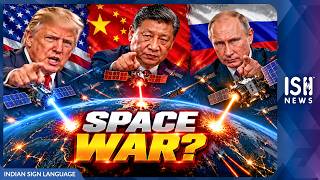
US Confirms Weapons in Space for the First Time
The US has confirmed that it has weapons deployed in space, raising concerns about growing military competition in orbit.
US Confirms Weapons in Space: Could Space Become the Next Battlefield?
Wars have been fought on land, at sea and in the air. Now, space is becoming another area of military competition.
US Air Force Secretary Troy Meink recently confirmed that the US has weapons deployed in space. He said these weapons are designed to help protect US military forces from hostile attacks. However, Meink did not reveal what the weapons are, when they were sent into space or how they work. This is the first time the US has publicly confirmed that it has weapons deployed in orbit.
US, China and Russia
The announcement comes as military competition in space grows between the US, China and Russia.
Chinese Foreign Ministry spokesperson Guo Jiakun said China opposes putting weapons in space and turning space into a place for war. But military activities in space are not new.
Outer Space Treaty, 1967
The US and Soviet Union began competing in space after the Soviet launch of Sputnik in 1957. Over time, countries also started looking at how satellites could support military operations.
Satellites are important for communication, weather information, navigation, surveillance and military operations. Damaging an important satellite could affect how a country's military forces communicate and operate. To create rules for space, the United States, Soviet Union and other countries signed the Outer Space Treaty in 1967.
The treaty bans countries from placing nuclear weapons and other weapons of mass destruction in orbit or on celestial bodies. However, it does not ban every type of conventional military system in space.
What Is Kessler Syndrome?
Another major concern is space debris, also known as space junk. If a satellite is destroyed, thousands of pieces could remain in orbit. These pieces could hit other satellites and create even more debris. A chain reaction like this is known as the Kessler Syndrome. It could make some parts of space increasingly difficult and dangerous to use.
What About India?
India has also developed technology to target satellites.
In March 2019, India successfully carried out Mission Shakti, an anti-satellite missile test. A missile destroyed an Indian satellite in low Earth orbit. With this test, India became the fourth country after the US, Russia and China to demonstrate this capability.
In May 2025, Pawan Kumar Goenka, Chairman of the Indian National Space Promotion and Authorisation Centre (IN-SPACe), said India planned to launch 52 satellites over five years to improve space-based surveillance capabilities for the defence sector.
This shows that India is also expanding its space capabilities as military activity in space continues to grow.